Tuesday, January 31, 2012

Tomb of queen Matilda and stained glass windows in abbey churches of Caen.

Caen was the capital of William the Conqueror before his conquest. Here he and his wife Matilda founded two great abbeys, one for women and one for men. Both abbeys are excellent examples of the Romanesque style of Normandy that led to the emergence of the Gothic architecture. There is not much calligraphy to be seen there at present, but what there is, is quite interesting.
The church of the Abbaye aux Dames has only one epitaph: that of the foundress, queen Matilda herself. It is a simple tombstone with only an inscription on it, it dates from late eleventh century. The letters are versals that seem to be Anglo-Saxon in style, which is perhaps not entirely surprising, as Matilda was the queen of England. The square "C" and "G", pointed "O", the broken cross bar of "A" and a bar at the top of the same letter bring to mind the incipit pages of such books as "Lindisfarne Gospels", but also books by the School of Winchester, closer in time. Interesting is the inconsistency: "E", "C" and "G" all appear sometimes square and sometimes round.
The church of St. Etienne of the Abbaye aux Hommes has no epitaphs at all, but it has interesting Gothic stained glass windows with some inscriptions in Gothic versals.





Friday, January 27, 2012

Parish church of Luckau in East Germany


Luckau is a little town in East Germany. The name sounds Slavonic, which is not surprising, as it lies on the verge of the area still today inhabited by Slav-speaging Sorben people. There are, however, no inscriptions in Slav language, even though one of vicars, whose epitaphium I reproduce here, came apparently from Bohemia (which is now Czech Republic). The area was strictly Protestant after the Reformation, which is probably the reason why there is very little figurative art in the church. Calligraphy, on the other hand, was fluorishing, the church is full of it. There are fantastic tombs in Baroque style with no images, just inscriptions. Various styles of calligraphy were used, often one inscription is part in Latin in italic script and part in German in Baroque fractur script. Here I reproduce some of those inscriptions. 


Friday, January 20, 2012

Ewelme


Ewelme lies away from the main roads and popular tourist trails, but for a calligraphy enthusiast it would be worthy to make a detour. Ewelme is a little village in southern Oxfordshire, six miles from Wallingford. The parish church there, built in perpendicular style, is very well preserved, but what is especially interesting is the chapel of St. George, whose walls inside are covered from top to bottom in medieval blackletter calligraphy. From the calligraphic point of view even better quality is the inscription on the tomb of Thomas Chaucer (son of the poet) in the same chapel. Other tombstone calligraphy in the church is also of good quality; here I present the best examples of various epochs. 


Monday, January 16, 2012

Jesuit church in Antwerp

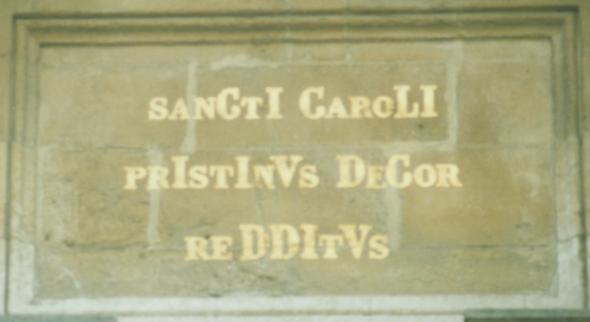
The Jesuit church of St. Carol Borromaeus in Antwerp has supposedly been designed by Peter Paul Rubens himself. There are three inscriptions on the façade. I am not sure whether Rubens had anything to do with them, but they are quite interesting from the formal point of view. 


Saturday, January 29, 2011

Dorchester-on-Thames

There are two Dorchesters in England, this one is a small town in Oxfordshire, south of Oxford. In fact it is hardly more than a village, but it has an interesting tourist attraction: a huge abbey church in perpendicular Gothic style. Just next to the abbey is a small museum of local curiosities, among them a document dated 1635.  It clearly was supposed to be decorative even though the hand itself was not of the highest quality. The initial and the bold letters are in fractur, whereas the body of the document is in italics.


Saturday, January 15, 2011

Kiezmarok

Kezmarok is a well preserved Gothic town in Slovakia, just east of the High Tatra mountains. The parish church is full of beautiful Gothic sculptures, whereas of calligraphy I found only one renaissance epitaph. I find it very graceful, perhaps even one of the best examples of capitalis elegans I've ever seen.


Monday, December 27, 2010

Gluckstadt

Gluckstadt is a little town in Germany, north of Hamburg. It lies on the Elba river close to its mouth. It is the region of Schleswig-Holstein; today it is Germany, but at the time this inscription was written it was a part of the Danish kingdom. The inscription is not dated, but the ornament around it suggests it is from late eighteenth century. It is also the time when this style of calligraphy appeared on monuments. This style is usually known in English as copperplate; normally it is characterized by a very narrow line, which clearly is not the case here. One can guess that the calligrapher used a thicker line here so the inscription could be legible from a distance.