Monday, December 27, 2010

Gluckstadt

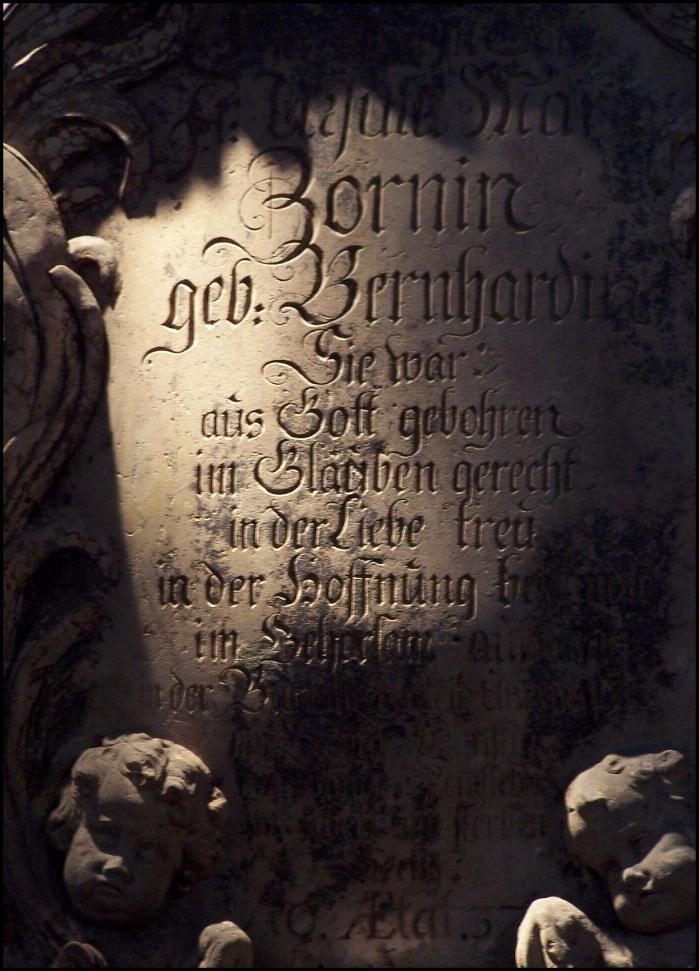
Gluckstadt is a little town in Germany, north of Hamburg. It lies on the Elba river close to its mouth. It is the region of Schleswig-Holstein; today it is Germany, but at the time this inscription was written it was a part of the Danish kingdom. The inscription is not dated, but the ornament around it suggests it is from late eighteenth century. It is also the time when this style of calligraphy appeared on monuments. This style is usually known in English as copperplate; normally it is characterized by a very narrow line, which clearly is not the case here. One can guess that the calligrapher used a thicker line here so the inscription could be legible from a distance. 


Saturday, December 11, 2010

St. Bees

St. Bees is now a small village on the coast of Cumbria in England. Its name comes from an Irish princess named Bega, who founded a convent here. In the church there are Gothic tombstones with an image in the middle and inscription in Lombardic capitals around. This is the early Gothic style, later Gothic tombstones have inscription in the lower case, i.e. textura. 


Sunday, November 21, 2010

Guildhall in Thaxted

If you have ever landed at Stansted Airport, you might have seen Thaxted from a plane's window, as it lies just a few miles away and the planes flying overhead are a constant cause of noise in this otherwise quiet Essex town. It is an old market town with a few historic buildings, one of which is the Guildhall, a timber framed structure dating from the 15th century. Now it houses a small museum exhibiting mostly old documents, which are quite interesting for a calligraphy student. The documents range from the 17th century up to the mid 19th, so one can observe the development in calligraphic styles.


Friday, November 12, 2010

Carlisle

Carlisle's chief tourist attraction is Hadrian's Wall, the best preserved fragment of which is in the vicinity. The town has also a fine cathedral with two points of interest for a calligraphy enthusiast. One is the Gothic polychromy at the back of wooden stalls, lives of saints in a form of a comic strip, each picture with a caption in mediaeval English. Here I reproduce two captions from a life of St. Augustine (the first one says: "They buried his body with deference here in his own church of Hippona") and two more from the life of St. Cuthbert. They were clearly written by a different hand, although at approximately the same time. The other point of interest is a treasury in the crypt, where old chalices and patens are shown. Some of them have inscriptions stating the name of the donor as well as the date. They are, of course, written in the most elegant style of the time. 


Thursday, November 4, 2010

Nikolaikirche in Berlin

Nikolaikirche in Berlin looks like a Gothic church. It stands in the tourist area of Nikolaiviertel and the usually open doors invite you to enter. When you do enter, however, a man approaches you and says (in German) that this is a museum and you must purchase a ticket to look around. It is an extremely uninteresting museum; its exhibition consisting mostly of old rusty artillery shells and a number of weathered epitaphs. Uninteresting that is, unless your hobby happens to be calligraphy. The epitaphs are in bad condition, but the calligraphy in some of them is excellent. In fact - although its creators didn't intend it to be such - it could be called a museum of calligraphy. The best inscriptions are in the Baroque German fractur. 


Tuesday, October 26, 2010

Torun

Torun is a towm in Poland where Copernicus was born. It was a very rich town in the middle ages and many monuments of gothic architecture survive there to this day. One of those gothic buildings in Marychurch, where medieval wall paintings are preserved. Some of those paintings are accompanied by inscriptions in monumental textura script. Two samples of those inscriptions I reproduce here. It has an eerie quality reminding me of Chinese calligraphy, where you can see the movement of the hand.


Saturday, October 16, 2010

Biecz

Biecz (pron. Byetch) is a pretty little town in southeastern Poland, at the foot of Carpathian Mountains. It has old wooden town houses and an interesting Renaissance town hall of extraordinary proportions, but here is a place for a Renaissance poem in its parish church. The script used is based on capitalis elegans, but at first sight looks poor quality. The interesting bit is the composition, the unusual "w" and "z" create a rhythm that probably was intentional.